
Fast Payout Online Casinos in the UK: What to Check
 Available in GB
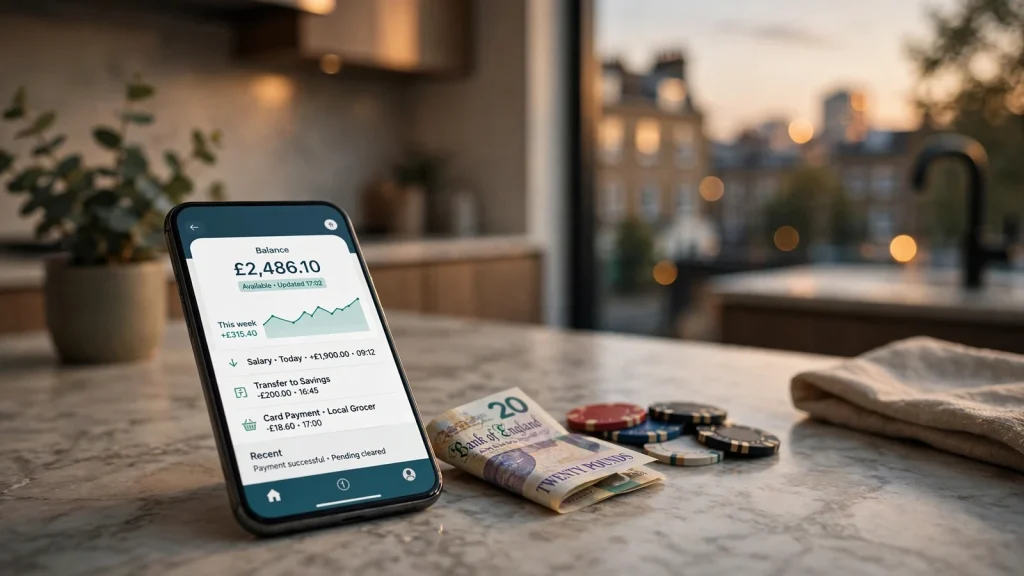
A quick withdrawal claim describes a stated service, not permission to operate or a guaranteed outcome.
What “Fast Payout” Can—and Cannot—Tell You
A promise of a fast withdrawal answers a narrow question: how quickly a site says it will handle a request for your money. It does not answer the more basic question of whether the operator is authorised to offer gambling to customers in Great Britain. Those are separate checks, and one should not stand in for the other.
The wording can make the distinction easy to miss. A site may describe itself as a fast-paying casino, or put a quick-withdrawal claim beside its games and payment options. That is a statement about the service it says it provides. It is not evidence, by itself, that the business has permission to serve you. A prominent claim is still a claim; its prominence does not make it a regulatory credential.
For readers looking for fast-payout online casinos in the UK, the sensible starting point is therefore not a league table of speed claims. A list that ranks operators by speed would need reliable, comparable evidence about how those claims are measured and what they cover. Without that, a “best” or “fastest” label may look decisive while leaving the basis for the comparison unclear. The fact that a site describes its payouts as fast does not establish that it is faster than another site.
Authorisation is a different matter. Casinos operating legally in Great Britain need a remote gambling licence, or must provide their service through a white-label arrangement with an existing licence holder. A white-label arrangement means the consumer-facing brand is connected to a business that holds the relevant licence; the brand name alone does not settle which operator is responsible. This makes it important to distinguish the name on a website from the licensed business behind the service.
The UK Gambling Commission regulates gambling offered by licensed operators in Great Britain. That includes keno when it is provided by a licensed operator. The relevant point is not that a particular game or payout claim sounds familiar, but that the service is being offered under the appropriate regulatory framework. A casino’s description of its withdrawal speed cannot establish that framework.
French Roulette at UK Online Casinos: Rules & Tables
This distinction matters because speed and authorisation concern different things. A speed claim is about an aspect of the operator’s service. Authorisation concerns whether the business is entitled to offer gambling to customers in the market. Neither statement proves the other: a site can make a fast-payout claim without that claim showing that it is licensed, and a licence does not, on its own, verify a particular speed claim.
The same caution applies to phrases such as “UK casino” or “UK-friendly”. They can describe how a site presents itself, but the wording is not a substitute for identifying the licensed operator. Nor does a brand’s familiarity answer the question. The business named in the regulatory information may differ from the name used in advertising, particularly where a white-label arrangement is involved.
That does not make every speed claim meaningless. It gives you a clearer way to read it. Treat it as a statement about the service the operator says it offers, not as a general endorsement of the site. If you are comparing casinos with fast payouts, keep the comparison separate from the check on who is responsible for the gambling service and whether the arrangement is authorised in Great Britain.
A “best fast payout” label also cannot resolve what matters to an individual reader. A broad ranking can hide differences in how operators describe their service, and a headline alone may not tell you what its claim actually covers. The useful question is not simply whether a site uses the word “fast”, but whether you can identify the operator behind it and distinguish a promotional description from its regulatory status.
This is a more limited conclusion than a list of winners, but a more dependable one. A quick-sounding promise can help you decide what to investigate; it cannot tell you whether the site is authorised to serve Great Britain. Keep those questions apart, and the phrase “fast payout” becomes a claim to assess rather than a shortcut to confidence.
Do
- Separate the check on who is responsible for the service from speed claims
- Identify the licensed operator behind the brand
- Treat a “fast payout” label as a service claim to assess
Don’t
- Use a list of speed claims as a starting point for research
- Assume a “best” or “fastest” label is based on comparable evidence
- Treat a prominent speed claim as a regulatory credential
Our top casino picks for the UK
- DieselwinBonus: Welcome Pack 250% up to £4000 + 200 FS · Payout speed: 1-3 business days
- NightLuckBonus: Welcome Pack + 805% Up To 6400€ + 280 FS · Payout speed: 1-3 business days
- JetsetspinsBonus: 200% Bonus + 100 Free Spins + Free Royal Wheel · Payout speed: 1-3 business days
- SpinFormulaBonus: 550% Up To £15,000 + 550 FS · Payout speed: 1-3 business days
- ZombillionBonus: Welcome Pack 250% up to £4000 + 200 FS · Payout speed: 1-3 business days
- WinBeastBonus: €5000 + 500 FS + €650 Freebet · Payout speed: 1-3 business days
Where a Withdrawal Can Slow Down
A casino may advertise fast or instant withdrawals, but that wording is not a guarantee that money will appear in your account immediately. It may describe how quickly the operator handles a request, while the time before funds are available to you can depend on other parts of the process. Read the claim as a statement to examine, not as a promise about the exact moment you will receive money.
The distinction matters when comparing sites that promote same-day payouts or describe themselves as among the fastest. A headline can leave out what the operator counts as the start of a withdrawal, what it means by “processed”, and whether the advertised speed applies to every customer and payment route. Unless those terms are clear, the headline alone cannot tell you when funds will arrive.
Start with the operator’s own withdrawal terms. Check whether the advertised speed is explained there and whether it is subject to conditions. Bonus eligibility, wagering requirements, excluded games, payment-method restrictions and expiry conditions can all affect withdrawals. If you have accepted a bonus, read the associated rules before treating a displayed balance as money you can withdraw. A promotion’s headline and its conditions are not interchangeable.
Also check whether the method used to deposit is available for withdrawals. A deposit option is not necessarily a withdrawal option. If the site’s terms say that a particular method cannot be used to receive funds, a claim about quick payouts will not resolve that practical issue. Confirm the available route and any conditions attached to it before depositing, rather than assuming that money will return through the same channel automatically.
Live Baccarat Online Casinos in the UK: A Guide
The wording of a speed claim deserves attention, too. “Fast processing” and “instant payout” can refer to different things, and neither phrase necessarily describes the full path from submitting a request to having usable funds. Look for an explanation of what the operator means, which payment methods the claim covers and whether the terms set out exceptions. If the detail is difficult to find, the boldest wording on the page is not a substitute for it.
None of this makes a slow or unclear claim evidence that a casino is unlicensed. Speed and authorisation are separate questions. But authorisation is essential: remote operators serving consumers in Great Britain must hold the relevant Gambling Commission licence. A site’s promise of quick withdrawals does not establish that it holds that licence, and a fast-looking website is not proof of regulatory status.
Before you deposit, check the operator behind the site and its licensing position. Do not rely only on a logo, a claim in an advert or the name of a brand. The company providing the gambling service is the relevant point of comparison with the regulator’s requirements. If the site identifies a different business from the one you expected, or makes its operator difficult to establish, pause rather than treating the payout claim as reassurance.
Keep a record of the terms you relied on, including the withdrawal conditions and any bonus rules that apply to your account. This can help you compare what the site said with what it later applies to a request. If an operator describes payouts as immediate in one place but attaches qualifications elsewhere, the qualifications matter. The useful question is not whether a casino uses the phrase “instant payout”, but whether its actual terms make the claim understandable and whether the operator is authorised to serve Great Britain.
Verify Withdrawal Terms
- Check the operator’s own withdrawal terms for conditions
- Review bonus eligibility and wagering requirements
- Confirm if the deposit method is also available for withdrawals
- Identify the operator behind the site and its licensing position
- Verify the operator’s status on the Gambling Commission register
A careful comparison may be less satisfying than a ranked list of casinos promising the fastest payments. But a ranking based on headline language would not tell you whether the speed applies to your payment method, whether conditions affect your balance, or whether the operator has the required licence. Treat the withdrawal claim as one piece of information, not a guarantee and not a substitute for checking who is offering the service.
A High Return Is Not a Promise of a Win
A game’s advertised return is a long-run measure, not a forecast for your next session. It describes how the game is designed to return money across repeated play, rather than the amount any one player should expect to receive. A high figure can therefore help you compare stated game information, but it cannot tell you whether you will win, how much you might win, or when a result will arrive.
This distinction matters when looking for a casino or game with a high payout. A figure attached to a slot is not evidence that it will produce a large win for you. Nor does a high stated return make a particular session predictable. Outcomes can differ sharply from the long-run expectation, and a short run of play may tell you little about how the game behaves over time.
UK Live Casinos: Games, Rules and Real-Money Play
Keno illustrates why a single “highest payout” figure can be misleading. Its house edge—the built-in mathematical share of stakes that a game retains over time—varies with the number of spots selected and the casino offering the game. One specialist affiliate review reports a range from 5% to 25% across the online keno games it considers. That is a report from one review, not a universal measure for every keno game or a settled market-wide range.
The house edge is also not the same thing as a payout to an individual player. It describes a long-run relationship between stakes and returns, while a particular keno draw may produce a different outcome. A game with a lower reported edge is not a promise of a win, just as a higher edge does not determine what a single draw will pay. The number selected affects the game’s terms, so comparing headline figures without checking what they refer to can produce a false sense of certainty.
The same caution applies when comparing high-return slots or other casino games. A percentage only has meaning in relation to the specific game and the conditions used to calculate it. It does not rank every casino, and it does not establish which UK casino has the highest payout. A casino-wide claim can obscure differences between games, while a figure for one game cannot be carried over to another.
If a site advertises a high return, treat it as information about the game’s mathematical design, not as a likely personal result. Check which game the figure concerns and how it is described. Then keep the practical distinction clear: an expected return is a statistical measure across extended play; a win is an uncertain outcome in an individual session. No headline percentage removes that uncertainty.
Attention: A high return figure is a long-run mathematical measure, not a forecast for your next session or a guarantee of a win.
Checking the Site Behind the Payout Claim
A website can describe itself as a fast-paying online casino, but that description does not establish who is legally responsible for the service. In Great Britain, remote gambling operators serving consumers must hold the relevant UK Gambling Commission licence. Checking the regulator’s public register is therefore more useful than relying on a logo, a brand name or a statement on the casino’s own website.
Start with the operator details shown on the site, including its legal business name and any licence number. Compare them with the UK Gambling Commission register, and check that the register entry relates to the gambling service you are considering. Do not assume that a familiar brand name will appear exactly as displayed to customers: some casinos operate through white-label arrangements with an existing licence holder. In that case, the relationship and responsible licence holder should be clear enough to verify, not left as an inference from branding.
The register is not a rating of payout speed. It helps establish whether the business behind the service is authorised to offer remote gambling to consumers in Great Britain. A claim about quick payment and evidence of authorisation answer different questions; one cannot stand in for the other. Even an impressive promise on a homepage tells you nothing by itself about whether the operator holds the required licence.
A specialist casino review reports that the UK Gambling Commission register dated 26 September 2026 does not show a LuckyPays entry under either the brand name or the stated domain, luckypays.io. That is a time-specific report, not a permanent finding: register information can change, and a reader should check the current register directly before relying on it. The useful point is the method, rather than any brand-specific conclusion: search using the business and domain details, and look for a matching, relevant licence record.
Live Blackjack Online Casinos in the UK: What to Check
If a site provides a licence number, search for it rather than treating its presence as proof. Then check that the operator named in the record corresponds to the business identified in the site’s terms and licensing information. If the details do not line up, or the operator cannot be identified clearly, a payout claim is not a substitute for resolving that uncertainty.
A properly authorised casino must provide details about its licence on the gambling website or app and link to its public register information. That gives you a route to check the claim independently. It is also a reason to be wary of pages that rely on badges or broad assurances but make the accountable operator difficult to find.
This check does not predict whether a payment will be prompt, and it does not turn a marketing claim into a guarantee. It establishes a more basic point first: whether the service is connected to an operator authorised to provide gambling in Great Britain. Only after that identity is clear does a promise about speed have a meaningful company behind it.
Why Keno Payout Percentages Vary
A payout percentage can sound like a single score for a casino, but the figure only makes sense when you know what is being measured. In keno, the amount paid depends on the stake and on how many of your selected numbers appear in the draw. A percentage without those details leaves out the conditions that shape the result.
High-RTP Slots in the UK: How to Compare RTP
The stake matters because it is part of the basis for calculating a return. The number of selected numbers that match the draw matters because it determines which outcome applies. Two keno bets can therefore produce different payouts even when they are made in the same game. Comparing their percentages as though they described an identical offer would be misleading.
This is why a casino payout percentage should not automatically be read as a simple promise about what you will receive. A percentage might describe a particular game or set of betting conditions; it does not tell you what one bet will return. In keno, the payout depends on the relationship between the stake and the matching numbers, not on a label detached from the bet.
When you encounter a payout figure, look for the underlying terms. Does it refer to a particular game, bet or set of number selections? Is it describing a possible payout for a given result, or a broader measure? If the basis is not clear, the percentage is difficult to compare with another figure. The same caution applies when a page places different games side by side: a shared percentage label does not prove that the figures were calculated on the same basis.
The distinction also matters when the word “payout” is used loosely. It can refer to the amount attached to a particular winning outcome, or to a percentage intended to summarise returns. Those are not interchangeable descriptions. In keno, a payout for a specific result is tied to the stake and the number of selected numbers drawn; it cannot, by itself, establish how another selection or game compares.
Best RTP casino slots UK: how returns work
A useful comparison therefore begins with the conditions, not the headline figure. Check what stake and number selection the information relates to, then establish what outcome the percentage describes. If those details are absent, treat the figure as incomplete rather than assuming it represents a general casino-wide rate.
This example offers a practical way to read claims about casino payouts, including figures presented alongside slot games. A percentage has meaning only in context. Keno makes that context visible: the stake and the number of selected numbers appearing in the draw both affect the payout. Without them, a bare percentage can look more precise than the information behind it.
Payment Choices and the Rules That Apply
A payment method tells you how money may enter an account; it does not tell you who oversees the gambling service. Before depositing, separate those questions. In Great Britain, commercial gambling has a single regulator: the UK Gambling Commission. Its remit covers online casinos and other gambling activity, and it applies to remote gambling offered to people in Great Britain even when the operator’s equipment is based elsewhere.
The Commission licenses both organisations and individuals. A business needs the appropriate operating licence to provide gambling, while people carrying out specified roles in the industry may need personal licences. This distinction matters because a familiar brand or a polished website is not itself evidence of regulatory oversight. The relevant question is whether the service is operating within the Commission’s licensing framework.
Legal Restrictions
UK-licensed casinos cannot accept credit cards for gambling or wallet payments that allow the use of credit-card funds.
That framework also shapes what happens when you open an account. Operators must verify your age before allowing you to deposit. They must prompt new customers to set a financial limit before the first deposit and make account-level limit controls accessible. These are safeguards to consider before choosing a payment route, not features that make gambling risk-free. A deposit should fit a budget you can afford to lose.
Payment choices are also restricted by the rules. UK-licensed casinos cannot accept credit cards for gambling, including credit-card funds routed through a money service business. They must also refuse wallet payments where the wallet would let a customer use credit-card funds to gamble. If a payment option appears to offer a way around those restrictions, that is a reason to pause rather than assume it is permitted.
Licensed operators must provide responsible-gambling tools, including self-exclusion, which lets a customer block their own access to gambling. They must also have an internal complaints process and give customers access to an approved Alternative Dispute Resolution service if a complaint remains unresolved. Those provisions concern accountability and safer account use; they do not promise a particular result from gambling or make every dispute straightforward.
So, when assessing an online casino with a fast-payout claim, do not let the payment menu stand in for the regulatory picture. Consider who is licensed to provide the service and whether the account safeguards are available. A choice of payment method may be convenient, but the rules governing the operator are what establish the framework in which that choice is offered.
Why Past Results Do Not Predict the Next Draw
A run of recent keno results can look like a pattern, but it does not tell you what the next draw will contain. Keno draws are independent: previous results do not influence future draws. A number that has appeared repeatedly is not therefore more likely to appear again, and one that has been absent is not due to return.
This can be easy to forget when you are looking at a results history. Repeated appearances may seem meaningful, while a long absence can feel like evidence that a number is “owed”. Neither impression changes the next draw. Each result stands on its own; the earlier sequence has no influence over it.
The same applies when you choose numbers based on past results. You can select numbers that have appeared often, numbers that have appeared rarely, or numbers with no particular history in mind. Those choices may make a selection feel more reasoned, but they do not make previous draws a guide to what comes next. A record of outcomes describes what has already happened, not what the next draw will produce.
This matters when a game page displays recent results or when players discuss apparent streaks. Such information can be interesting to look at, but it should not be treated as a forecasting tool. A streak is a description of a sequence, not a signal that the sequence must continue or reverse. The next result is not adjusted to compensate for what came before.
Nor does an independent draw mean that every individual choice will produce a satisfying result. It means only that previous draws do not determine the next one. A disappointing run does not create a reason to expect a favourable result, and a favourable run does not establish that similar results will follow. Treating either as a prediction confuses a past record with influence over a future draw.
Keno draws are independent; previous results do not influence future draws, meaning a number’s past frequency does not affect its likelihood of appearing again.
If you are reviewing keno results, keep that distinction clear: history can show the outcomes already recorded, but it cannot tell you which numbers will appear next. No strategy based solely on earlier results can change that relationship. The draw does not remember the sequence, even when a player does.
That is separate from administrative matters such as how a casino handles a withdrawal. Game outcomes and the processing of funds are different questions. A past run of keno results cannot predict a future draw, and it says nothing about how quickly a casino will process a payout.
What Keno Payouts Depend On
In keno, a potential payout is tied to two things: the stake you place and how many of your selected numbers appear in the draw. A result cannot be judged by the number of matches alone, because the stake is part of the calculation too. Nor does choosing numbers by itself tell you what a winning ticket would pay.
Before placing a bet, look at the game’s own paytable: the table showing what different results pay for the selected stake. It lets you see how the game treats a particular combination of choices. Check that you are reading the row for your stake and the outcome corresponding to the number of selected numbers drawn. A figure shown for one stake should not be treated as the return for another.
Your number selection defines what counts as a match. If the draw includes more of your chosen numbers, that changes the outcome recorded for the bet; the game’s payout terms determine what that outcome is worth. This is why a headline figure, detached from the stake and the result it applies to, can give a misleading impression of what you might receive.
The same caution applies when comparing keno with slots. A slot’s advertised return figure is not a direct guide to what a keno ticket pays, and a casino’s general description of payouts does not explain the terms for a particular keno game. To understand a possible keno return, you need the game-specific paytable and the stake attached to the bet. A broad claim about the best-paying casino or game cannot replace those details.
It is also useful to separate the size of a possible payout from the likelihood of reaching the matching result. The paytable describes what the game assigns to an outcome; it does not make that outcome certain. Selecting numbers because they seem promising does not change the terms shown for the stake and match result.
If you are comparing two keno games, compare equivalent stakes and the same kind of result in each game’s paytable. Otherwise, you may be looking at unlike figures. The practical question is not simply which game displays the largest payout, but what stake and number of matches that figure depends on. Read those conditions before betting, rather than relying on a headline claim to describe what your own selection could return.
Why an Unlicensed Site Is Not a Safer Shortcut
A site may describe itself as regulated overseas, but that does not make it authorised to offer keno to customers in Great Britain. Operators selling remote gambling to people there must hold the relevant UK Gambling Commission licence. If a site offers keno to British players without the required authorisation, it is operating illegally, whatever another regulator’s rules may say.
That distinction matters when you are weighing claims about casino apps or online casinos with high payout rates. A payout claim describes what a site says about its games or payments; it does not establish that the business is entitled to serve you. Nor does a prominent brand, polished app or foreign licence replace the authorisation required for the British market. The legal question comes before any claim about a game’s return.
This does not mean that a foreign licence is meaningless in the place that issued it. It means that it is not a substitute for a UK Gambling Commission licence when an operator is offering remote gambling to consumers in Great Britain. The relevant standard is not simply whether a site says it is regulated somewhere, but whether it has the authority required to serve this market.
There is also an important difference between the operator’s obligations and the player’s position. The illegality described here concerns an unlicensed site offering keno to British players; it does not mean that a player faces a fine or criminal prosecution merely for using such a site. Still, the operator is outside the UK regulatory system, so a claim of overseas oversight should not be treated as equivalent to local authorisation.
This is why searching for the casino game with the highest payout cannot answer the more basic question of whether a site is legitimate. A large-sounding figure, quick-payment promise or list of popular games tells you nothing by itself about the operator’s status. Treat those as separate matters: first establish whether the service is authorised to operate in Great Britain, then assess its claims. A foreign regulatory badge is not a shortcut around that requirement.
Treat “Quick Payout” as a Claim to Verify
A promise of a quick payout describes what an operator says about handling withdrawals. It does not, by itself, show that the site is authorised to serve customers in Great Britain. Nor does it tell you whether a particular game will produce a win. Those are separate questions, and treating them as one is an easy way to read more into a headline than it can support.
Check who operates the site and whether the relevant business appears on the UK Gambling Commission’s public register. A brand name on a page, or a statement that the service is regulated elsewhere, is not a substitute for the authorisation required to offer remote gambling to consumers in Great Britain. The payout claim may be prominent; the identity and licensing details behind it deserve at least as much attention.
Game results sit on a different track from withdrawal administration. In keno, each draw is independent: earlier results do not affect the numbers in the next draw. A run of apparent near-misses does not make a win more likely, and a previous win does not make another one due. The speed at which a casino says it processes withdrawals has no bearing on either outcome.
That distinction matters when comparing claims. “Quick” is not a measure of a game’s chance of paying, and a winning result does not establish how quickly funds will be handled. Conversely, a fast-sounding payment promise tells you nothing about whether the next keno draw will match your numbers. Neither claim should be used as evidence for the other.
Before depositing, establish that the operator is authorised and read the terms that apply to the account and payment method. Then assess any withdrawal statement as a claim about administration, not as proof of a likely return or a favourable result. The words may be reassuring; they do not change the rules of the draw or the requirement for proper authorisation.
Is LuckyPays licensed by the UK Gambling Commission?
The UK Gambling Commission register dated 26 September 2026 does not list LuckyPays or luckypays.io. Check whether the service identifies a different licensed operator, as a brand may operate through a white-label arrangement.
How can you tell whether an online casino is licensed and legal in the UK?
Identify the business responsible for the gambling service and check that it holds the relevant UK Gambling Commission remote licence, or operates through a white-label arrangement with a licensed business. The brand name or a claim that a site is UK-friendly is not enough on its own.
Are fast withdrawal casinos safe to use in the UK?
A fast-withdrawal claim alone does not show that a casino is authorised or safe to use. Check the responsible operator’s licensing status separately; the speed claim is not a regulatory credential.
Games
Prepared by the Hot Streak Online editorial staff.